Securing Sexuality is the podcast and conference promoting sex positive, science based, and secure interpersonal relationships. We give people tips for safer sex in a digital age. We help sextech innovators and toy designers produce safer products. And we educate mental health and medical professionals on these topics so they can better advise their clients. Securing Sexuality provides sex therapists with continuing education (CEs) for AASECT, SSTAR, and SASH around cyber sexuality and social media, and more.
Links from this week's episode: Privacy, Security, and Personal Boundaries in the Digital Age
Privacy, security, and personal boundaries are increasingly complex in the digital age. Let's examine these challenges and their broader implications for individuals and society. Privacy, recognized as a fundamental human right, has evolved from protecting physical spaces to encompassing virtual ones. The digital age introduces a dimension where physical and virtual spaces and personal information are pivotal.
Social media platforms have revolutionized how people interact and share information. While these platforms offer benefits like connecting with loved ones, they also pose significant privacy risks. Many users share personal details, photos, and opinions without fully understanding potential consequences, such as unintended sharing or data breaches. This behavior has led to a gradual erosion of privacy, making personal information accessible to a wide audience and potentially leading to identity theft or other serious consequences. Data collection and surveillance are prevalent practices in the digital realm. Companies collect vast amounts of data on individuals, from browsing habits to purchasing preferences, raising concerns about privacy compromises and potential data misuse. Moreover, government surveillance programs and the increasing use of facial recognition technology further blur the boundaries between privacy, security, and personal freedom. Establishing personal boundaries is not just crucial in maintaining privacy and protection, it's also empowering. By defining clear boundaries about the information they are comfortable sharing and with whom, individuals can take control of their digital presence and mitigate risks associated with privacy breaches. Given the increasing vulnerability of privacy, it is imperative for individuals to take proactive steps to safeguard their personal information. Implementing strong passwords, regularly updating software and applications, and being cautious about sharing sensitive information online are vital measures. However, it's equally important to stay informed about privacy policies and terms of service, as this is a responsibility that falls on each individual for their own data protection. The intersection of privacy, security, and personal boundaries has far-reaching implications for society. It raises crucial questions about the balance between individual freedoms and collective security. Furthermore, the erosion of privacy can profoundly affect marginalized communities, who may be disproportionately impacted by surveillance and data breaches. While technology has undoubtedly enhanced our lives in numerous ways, navigating the digital landscape with caution and mindfulness is crucial. By understanding the evolving nature of privacy, establishing personal boundaries, and implementing robust security measures, individuals can strike a balance between embracing the benefits of the digital age and protecting their privacy and personal freedom. A collective effort is required to shape a future where privacy, security, and personal boundaries are respected and upheld digitally. Key Concepts:
Hello and welcome to Securing Sexuality. The podcast where we discuss the intersection of intimacy and information Security. I'm Wolf Goerlich. He's a hacker. And I'm Stefani Goerlich. She's a sex therapist. And together we're going to discuss what safe sex looks like in the digital age. So I tried to get you to do this intro live in person.
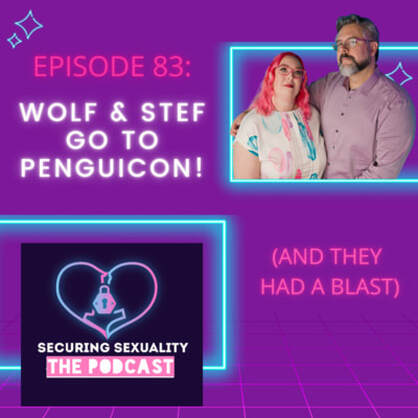
And you're like, baby, No, I mean, it's a little weird to do it when the people that are you're with don't know your podcasters. They knew a lot of things about us, but I don't think they knew about Securing Sexuality really well. I thought like the Q and a well before we get too far. Where were we? Where the heck were we this time? No, I asked you. Where were we? I was hoping you remembered. No, we were at Penguicon We finally I finally, after years of hearing about Penguicon about, Neil Gaiman about, you know, Wesley Crusher repeatedly saying he would be a guest and then, cancelling at the last minute. Terry Pratchett has been there. Terry Pratchett on the cybersecurity side. my man Bruce Schneier. speaking of Securing Sexuality. F friend of the show Eva Galperin has been a a guest of honour. Johnny Christmas, who is at our conference Johnny Christmas as well. So couple, couple alumni from Securing Sexuality the conference. And this year you were a guest of honour. We were both guests of honour. Well, some people have more honour than others. I have no honour. I mean, mine is limited. I've been told I bring shame upon my family and our cows many a time. I've seen those cows. They they they can take it. They're sexy little cows admittedly slap happy. Apparently we did. We did sex, tech, Q and a We did Securing Sexuality. The the question and answer session, among other things. That was the first session. And then you did two more the next day, and I did three more. Although I wasn't supposed to, that third one was a surprise edition. Well, I mean, you were like, Hey, what do you mean? What talk could someone give with no notice? I know what talk I could give with no notice. Yeah, The lesson I learned is stop opening your big mouth. It was a really good talk, though. Oh, well, thank you. Do you wanna tell them what it was? how to choose a sex toy? Indeed. So if anybody wants to know how to how to how to buy a sex toy, Um hit me up and I will give you completely non brand affiliate. No sponsorship partnership agreement answers Just my my pure raw opinions, replete with a 50 minute slide deck which I feel like you could have went on for another hour. I could have because I didn't even have time for Q and a. But I now have curated a delightful list of toys that are the Stefani's recommends of the world. So we've been asked a lot of questions over the past weekend. And I I know we could We could do the travel log thing we could share, you know, hot top moments and everything. This is a very unique event. There's a lot of fun things happening. There's a lot of varied programming, like all over the place in terms of all sorts of topics I had never been before, and all I thought I knew about Penguicon was that it was a Linux conference, but Linux, I guess, is open source software. Yes. OK, so that explains why it's now like sci fi and open source. And that meant, you know, I stumbled into talks on everything from, well, you know how to buy a sex toy to your how to survive the robot apocalypse to knitting lessons to some dude talking about income taxes. I mean, it was robust and diverse. It was It was a cool experience. So what were some of the questions that we've been asked that stick out to you? What are some of the things that we answered that you think may benefit this podcast audience? May may benefit our our friends here in podcast land. See, that's hard because so many of the questions I was getting I I feel like I was giving them the same answer, which was, There's no way I can do the situation justice in five minutes. Why don't you hit me up and I'll refer you to a therapist near you? I was getting some good engaged, like case consult questions. Yeah, but we also got some that were very appropriate for this audience, right? Like we were asked, How do you stay private on social media. Oh, that's true. And what did we tell them? I don't know. I was asking you. What do you What do we tell them? I don't remember. It was all a blur to me. I thought you were gonna tell people how to stay private. You're the cybersecurity, dude. I'm the one that's like, how to buy a dildo. You're the one that's how to stay private on the Internet. Well, I don't know that that's necessarily true, because you've given a lot of good advice in terms of what to share and what not. And I've also very rapidly watched you find find a lot of, intel on people. You are like the the search social media. Figure out who this person is champion list of this household. I have the cent book. I do not understand anything in the ocean book, but it sits next to my desk and I pretend I'm consulting it when I'm using my Google food skills. And you look so smart and so and you pull your hair back and you got that sort of, like, naughty librarian thing going. Oh, it's fantastic. So I mean, I think a lot of my advice was, um you know, first off, just get off social media when we're in the open source world. One of the things that I was touting and and advocating for was mastodon, right. These these open source community driven sites that are not data aggregation, platforms. So I did talk about that. I talked about, you know, limiting what information is shared. Not sharing your birthday, not mentioning that putting in fake data for that. Putting photos in later. Not having information in your photos that could, you know, be used to identify you those sort of things, paying attention to what's in the background of your photo, which was a tip we first learned from Luna, right? Guest of the show. They had a good follow up to that too. Right? Which was how does the Internet know if I'm gay? If I've never searched for anything involving sex, and I got to share my fun fact that Facebook knows what you've searched for even if you never hit enter on the search bar, which I really is that going to get fixed? Some? No, of course not. I've learned not to ask that question on this show. Nothing is that can be monetized will be fixed. That is what I have learned in the going on, You realise in a month it'll be two years of doing the show. It's all a delightful blur. But the one thing I have learned nothing that can be monetized will ever be fixed. Oh, nothing that will be monetized will ever be fixed. That's a good line. Another good line you had in your sex tech Q and a was in the womb. Everyone is Yes and yeah, I mean, where else but apparently at Penguicon can you learn how to knit, learn how to embroider, buy an awesome deck of tarot cards and then have a brief discussion of foetal development all in the span of three hours? It was a thing. It was glorious. So what was some of the questions that were asked that stuck out to you? One of the big ones for me was, you know, we talk a lot about trying to make social media slippery, not sticky, trying to create systems that move people towards each other in real life instead of keeping them stuck with screens between them. And so one of the questions that I thought was fascinating was, How do you meet women in tech spaces? Because as a tech adjacent woman who has been in many a tech space, I I've had uncomfortable encounters, and it was interesting that the question was not How do you meet people, or even how do you meet women? It was fascinating, and I think, really understandable from the person that asked the question that they wanted to meet people in spaces where they felt comfortable and to to find and interact with people who understood their world and their work and their values. It it makes perfect sense, right? Like if I am somebody who works in the nonprofit sector and is deeply passionate about, I don't know, youth sports. I'm gonna want a partner that also understands working in the nonprofit world and enjoys coaching Little League. So it was a fair question. I just don't think they were prepared for our response. Probably not because my response was Stop it. You're being creepy. I mean, I that wasn't exactly my response. I was much nicer. I mean, there was more to it than that. You explained the creep factor, and I shared a personal story. But, why is it creepy, baby? Well, you know, because people are in spaces for the reason they're in spaces. And a lot of times when I hear feedback from my friends who are women, about why they don't go into tech spaces is because they do feel that they're being hit on or they do feel that they're being objectified. And my whole point was, there's there's a really great time and place for hitting on people and dating, and there's a really good time and place. We're just focusing on what we're there for. And you really need to know. Why are we entering into these spaces and come at it from that lens, right? Like you wouldn't expect to get tech support on tinder. You shouldn't expect to get, lewd comments. when you're at a tech conference, you shouldn't expect it. But I feel like most women expect that in most spaces, and they shouldn't. It's not exclusive to tech I, I think, especially in any place that has been traditionally sort of. I know people don't like talking about male dominated whatever but traditionally majority male spaces. the women that start to make those spaces their home do experience a certain level of Oh, why are you here That, they don't in more majority female spaces. And now we add in the experiences of our trans friends and our non binary friends and our gender fluid friends, And it can be really difficult for somebody who's dating and wants to find somebody who shares their career understanding their values, their interests. to understand why this self selected community of people that I know gets that isn't a great dating pool. Right? Right. So we we had that question. I think we did a good job navigating that. Getting some feedback, you know, make friends. Where it goes from, there is is fine. But there there is a lot of value in the friend zone, which I think oftentimes gets overlooked or forgotten. I also got inter asked an interesting question. we were talking about, deep fakes, and we're talking about the Taylor swift situation and how, um there was an entire, you know, group on, four chan and on reddit who are always trying to figure out different ways to get past the philtres to get these, like, off the shelf. AI systems in this case was Microsoft's AI to, you know, do something illicit, right? In this case, it was, you know, to to generate some, some deep fakes of, pornography with Taylor Swift. And so the question I was asked was, Why not just use stable diffusion? OK, I had a question about that question. Yeah. What? Stable diffusion? All right. So stable diffusion is, it it's still an AI model. It's still within the realm of generative AI, but it's really focused in on, doing image manipulation instead of being a large language model, which is, like, we just keep feeding text to this language to it learns how to speak like us. It uses, a type of machine learning called late, diffusion, which doesn't really matter. But what latent diffusion does is it's It's a analysis technique for images, so it allows you to generate images, manipulate images, these sort of things. it's being built into other products, but also what's unique about stable diffusion and why it's a really good tool for doing really evil things is stable. Diffusion is open source, and you can download and run models yourself. So whereas like Microsoft's A. I and open A, I have to be hosted and run and therefore have philtres that active security teams are maintaining a stable diffusion. You would just download run, and you would do it without any philtres and therefore bypass any sort of corporate security. OK, that's a lot of techie language. So now bring it back to the question. How does all of that turn into AI nudes so stable. All right. Did did I tell you about the the AI camera That only takes nudes? No. How does it wait? So, like, if I'm wearing clothes, it will refuse to take my picture? No. If you're wearing clothes, it will analyse your body, and it will create a negative picture of you within the space. That's revolting. Why is that a thing? they say they created it to, raise awareness and critique the current like trajectory of image manipulation. It's called a nua camera. NUC A. For those of you who might be wondering what I'm talking about. It will take photos and create a nude version of the photo. Now to do that, it's running a VA local little AI with no guard rails that has been trained specifically on pictures of nude men and women. So to do that, you'd have to, like, get an AI that doesn't have a high degree of controls around it. Censorship around it, protective factors around it. so of course it's running stable diffusion. This is a really good use case of stable diffusion being used in one of these types of projects. So you were explaining deep fakes. And the question was, Isn't there a better, easier, more tech friendly way to create false notes? Correct. And I'm like, Yes, there is, Of course, stable diffusion will do it, but that misses the whole point. The people who are doing this, who are, on four Chan and on Reddit. They're doing so because they want to make a splash, right? The point that Microsoft, Microsoft's version of Open AI models, created the image. That's the point for them. That's that's the That's the reason they did it. Anyone could create, naked images of anybody. But the very fact that he tricked an AI and to do it is what creates the chaos and what's creates the problems. As a matter of fact, we're actually starting to see something intriguing where some people again, Because this is about creating chaos and about trolling and, you know, all the sort of, like, negative aspects Internet. We're actually starting to see the reverse. People are now trying to trick Microsoft AI and using those things to put clothes back on people. Yeah, I saw that there. There's an article, you know, we'll post the link in the show notes. But the thing about it is that, you know, when I first saw the headline that people are using AI to rec clothe women, you know, my first thought was, religious orthodoxy and and I don't mean like Orthodox Jews, I mean, across all religious traditions, the more the more rigid one is in their religious interpretation, the more modesty they prefer in their culture. And so there are, you know, magazines that will Photoshop women out of pictures for modesty's sake. There are schools go through before their books are given to kids and, like use a Sharpie to raise necklines and to lower like sleeves in the illustrations. So I thought this was going to be coming from a generally well intentioned if perhaps you know, not universally held sort of modesty, Norm. And no, really. When you dig into it, it's just dudes looking to shame women who are comfortable posting naked photos. Yes, yes, which I mean here, here's that was my whole point. And my answer to that is the fact the, uh fact that trolls convinced AI to take clothes off of somebody is not because they wanted to see nudity. It's because they wanted to make a point and to make you know, people feel bad and everything else. and this is a A really good example of the exact opposite. We're putting clothes back on, but it's the same underlying group. It's the same underlying motivation, all right. I get to be the, podcast Cassandra that I often am, which is Are we using AI for anything good right now when it comes to images, is there any good happening or is it all just creating more nudes or shaming women who are already nude. I think there are some good uses of AI. I think about the photographer we worked with for your your Detroit photoshoot, right? And she was mentioning that she was using adobe. And she'd say, You know, please take out the shadow, or please take out you know that that bottle or, you know, the there is some trash in the fountain. Please remove that trash from the fountain and then the AI just goes and does it. I think there's some really good photo man going on, especially if we're putting it in the hands of artists. so yes, I'm gonna say yes. OK, But you mentioned artists. And that brings to my mind another interesting comment that we heard talking to folks at this conference. They had an amazing maker area. You know, they had a space for authors. I had my books available there, and I really just did this amazing alchemical process of turning my books into souvenirs from the maker spaces. So many amazing artists with things to buy and pretty things to wear. And I did AI did a pretty good job at only trading books for Pretty, I think. But one of the artists that we were talking to said that now, in like the art world, if you don't like somebody or if you're competing with them or you want to, you know, hinder their career or their progress, that they're training AI on competitors art so that then their unique style, their approach, the thing that makes their art their art just becomes another piece of AI and easily replicated. Tell me more about that because that I thought was mean. Baby, it's just mean. I think what you had said was, when that was asked of me, you watched as my brain broke. I did. It's very rare to see you caught off guard, and I literally watched your brain like stutter, freeze and reboot before you could respond to her because it just seemed you mean is a good word for it. It just seems so cruel. Like I'm mad at an artist or I don't like this person. Maybe they didn't, you know, do something that I wanted them to. Or maybe they view them as a competitor. So I'm gonna feed all their work to the AI and destroy their livelihood. I had never heard of that before, and it just struck me as being so benevolent and so outside of like my my, you know, way of thinking. Now again, this comes off of us just talking about how an entire swath of the Internet is using AI to embarrass women. So I suppose it shouldn't have caught me off guard. I should be more jaded at this point in time, but it really did like, sucker punched me that. Why would you Why would you sabotage your fellow artists this way? Yeah, that was a powerful moment because I think so often, you know, when we're having these conversations or even when we are like having a chat with a guest. And we're talking about AI. It's usually I'm gonna say a more technical conversation, and often where we tend to focus is on how AI can be used to manipulate pictures of people. And that was the first time I had really thought about the way that AI can be used to manipulate art and artists and artistry and to undermine somebody's burgeoning talent or their ability to stand out as talented artists. by using a a an online app. Yeah, I. I was very disappointed to learn that fact. So I have a question for you, though Not a question we were asked at the conference, but a question for you, about our time at Penguicon, one of the talks you gave where some of these, you know, points that we've been discussing came up was your new like how to survive the robot apocalypse talk. And it was fascinating because everything you were doing and and talking about was like how to subvert AI how to break AI how to get around the robots. And I found myself sitting there going, But aren't we just teaching people how to do the bad stuff? We don't want them to do. Like when I worked with kids that were being bullied, my response was not to teach them how to hit better, right? Like so I I get in your world. There's, like offensive and defensive security. Logically, I understand it, but emotionally, rationally sitting in the room, listening to your actually pretty flipping cool new talk. I kept wondering why we're telling people how to do these things. Well, this gets back to the idea of hackers as the Internet immune system. Right? My my goal with that talk. And by the way, this is surviving the robot Apocalypse, Part two. So I gave part one about a decade ago, talking about all the different ways that you could subvert input controls on a variety of different systems, including, vision, and others. And the the reason for that was to raise awareness that these were problems to then offer a couple solutions. Right? Because if we don't raise awareness that these are problems and then the people building things will not build controls then. And I wasn't releasing anything that was new. I was just bringing it all together, right? I not like Here's the zero day exploit and a completely unknown way to flip over an LLM. No, these were all very common known ways. that, that AI can get disrupted. And so my hope in that talk was by having a more fun hook, as opposed to me being like, I'm going to now lecture you on how you LL MS will be circumvented and why you need to put controls in by using the framing of surviving a robot apocalypse. My hope is to reach the people who are building these systems so that when they're asked Hey, can you stand this up? They're like, Yeah, I can. But wait a minute. I remember Wolf saying Da da da da, da da And therefore we should consider XY and Z. I get that. But what's gonna stop any of them from just leaving and going and doing all the the fancy new skills you taught them to do mean things? Well, hopefully none of them are mean because goodness gracious, sabotaging artists. I mean, everybody we met was very nice. I'll give you that. Yeah, everyone's great I. I want to clarify my question. Is not this audience specific? It's more of a philosophical, high level question. This is This is the fundamental question we have about any security technology. Take the flipper and all the arguments are going on with that right now. What's to stop anyone from downloading Flipper and stealing a Kia? Not a whole lot, not a whole lot on the flip side. You know, if we prohibit R of radios, only Kia car thieves will have flippers. Let's not let that reality exist. What else? We've been talking for a while, and I feel like I've been asking you a lot of questions about your side of our Penguicon experience and your talks and the things that you know have been on my mind since we got home. But what what's been on your mind? what has been on my mind? I'll tell you the one thing that I've been thinking about again and again and again and again and again ever since we were asked. It was the following question, and this was from, one of the the women attendees, and she basically said, Look, I've got a lot going on. I've got a lot going on in my day. I've got a lot going on in my life. I already know that this site will spy on me, or that site will spy on me. I already have had conversations, with friends and then open up my my app and immediately got an advertisement for whatever we're talking about. I already know that you know, the every government under the sun may be accessing my data. so I don't care. It's done in my mind. It's done. I don't want to spend a whole bunch of time trying to protect myself because I don't have the time to spend to protect myself. I mean, to be honest, that's the question we hear all the time when we're trying to explain why we do this podcast, right? A lot of the time people just be like, OK, but there's nothing I can do. It's all big companies. It's all giant corporations. It's all technology. I need to live my life, do my job. Parent, my kids. So what's the point of even trying, do you think? And I know this is like a protected term in your world, but do you think that this has become a form of learned helplessness among a certain percentage of Internet users? You know, I? I think so. I think that there is a financial incentive for giant corporations and products that that use, the Internet to encourage people to feel like there's nothing they can do. I mean, if I if they make the terms of service. Jargony enough if they make the privacy policies 37 pages and you have to click yes, to update or to access what you're trying to use at all. there is a way to make a user's experience easier, and there's a way to make a user's experience harder. And I definitely think that the user experience of privacy has been made as difficult as possible because if it were made easier, people would push back more, they would find it. They would find information more accessibly. They would find answers and solutions and steps they could take to be, more simple in how they're explained or defined, and they would do those things. So I do think that the metas of the world, the alphabets of the world have a vested interest in keeping these things complicated so that people just develop this mindset of, Well, I can't understand it all anyway. So what's the point? Yeah, and you know, one of the things that you said, and I don't even remember what talk this was was Oh, if you're at the sex shop, read the privacy policies before you buy it and I was thinking about how convoluted privacy policies are, and we've talked about this in the past, by the way, TOSDR. So terms of service didn't read, which is a a website that gives you, like, really brief, actionable terms of service things. But they often times, of course, don't cover sex toys. So if the TOSDR people are listening, please cover sex toys. Alternatively, if anyone's like, Hey, I want a project which I could do in this world might I suggest a TOSDR of sex toys? But that was just one example, like who's got 45 minutes to read privacy policies before they buy a toy? this this is this isn't a a very good question, but I don't know that I've got a good answer for for this person, right? Like there. There has to be a line in terms of how much time you're willing to spend to protect yourself. And I I'm concerned about the learned helplessness side, and I don't know how to get from that to, like, active protecting without saying Yeah, you know, spend eight hours a week trying to, you know, Fend off the encroaching, privacy and security library, which we live in. So then what's the solution? I mean, we've talked in the in the past about having a personal tech risk framework, a personal privacy and data security risk framework. Is the solution to respect this person's right to just be like, you know what? Whatever I hope not. Because the more and more people do that, the less and less anything will be fixed back to your point about once it's monetized, it never gets fixed. I if no one cares and no one's complaining, it's not gonna be an issue. Nothing is gonna be done. But it does make me think that, have we talked about System one and System two thinking here? if so, it's been long enough to get long enough ago that I'm not remembering it. So how about it? So System one and System two, the the original book in this was, I think, thinking fast and slow. System one is your intuitive processes, right? And system two is like you're slower or calorie intensive, more energy intensive processes. When you're going to build up expertise, you're basically taking from system two and adding the system one, you're you're spending a lot of calories and spending a lot of energy and spending a lot of time to think through through do things with intentionality do things with mindfulness, as they say now, consciously. But what you should be doing is training your system one thinking so that just happens automatically. We know that feel because we are talking about the differences that some speakers were complaining about. Oh, my old hotel. I used to be able to present like this, but now I'm in a new hotel, you and I that that's a system two thinking, right. I gotta think about the room. You and I are presented so much, we're like, I don't care what room you put me in. Just point me towards the front and make sure the clicker works. System one thing, and sometimes we don't even need the clicker to work. Yes, On one of our talks, I was your clicker. You just did finger guns at me, and I clicked every time to advance it. But so one of the important things about building street smarts when it comes to technology and privacy. One of the important things about building street smarts is trying to train the system. One thinking I I if our listeners take away Oh, According to Stefani and Wolf, I have to remember these 40 things and think about them all the time. We probably failed. If you had a really good example about this. Tell me the example that you gave at the event when you're talking about charger cables. when I was telling people that the Manta is one of my favourite toys and how I got the Manta Devi that I have that charger cable, not that charger cable. What? What I said that I had found really helpful and that we seem to get a lot of enthusiastic response around was when we go to conferences and we give therapists, data blockers USB condoms, because in your world, those are pretty ubiquitous to the point where when we go to a tech conference, people are looking at our data blockers and they'll be like, I don't know, Is this the best kind of data blocker? Do you have? The latest technology is this story, and I'm like, Dude, it's free. Take it or leave it. But in my world, people get very excited that there's this little device they can put on the end of their charter cord. And once it's there, they can forget it's there. They could just leave it there forever. It is. Set it and forget it protection that lets them charge their phone, share a car ride with a friend and not have to worry about things. That's the level of technology. We need more of the level of privacy protection we need more of and taken up one level system two thinking I need to remember to put it on. Oh, I need to understand what it is. I need to plug it in and then system one, thinking I just need to grab my cable every single time is really where where we need to to find a sweet spot. I think in our security advice, you know what would be awesome to do, and this is probably my last big thought. Before we wrap up, we should have like a, safe sex and 30 minutes a month pamphlet or something. If you could only have a half hour or an hour a month What should you do? I like it. I think if we could get it down to 30 minutes, period, people would be all in absolutely with that, creating safer, more enjoyable relationships online. 30 minutes at a time. thank you all for tuning into Securing Sexuality, your source of information you need to protect yourself and your relationships. Securing Sexuality is brought to you by the bound Together Foundation 501 C three nonprofit From the bedroom to the cloud. We're here to help you navigate safe sex in a digital age. Be sure to check out our website securing sexual.com for links to more information about the topics we discussed here today as well as our live events and join us again for more fascinating conversations about the intersection of sexuality and technology. Have a great week. Comments are closed.
|
join us on air!Archives
August 2024
Categories |


RSS Feed